
- Compare agents
- Online valuation
- Explore my area
- Home toolkit
- News & guides


- Estate agents by area
- Sold house prices by area
- Estate Agent ValuationRequest an in-person valuation with an agent to discover your property's true market value.
- Online Valuation ToolGet a free instant estimate of your home's value.
- EPC CheckerFind out if your home has a valid Energy Performance Certificate.
- Listing MonitorAlready on the market? See how your online property advert is performing.
- Selling guides
- Estate agent guides
- Mortgage advice
- Conveyancing guides
- Property news See All News & Guides
Agent shortlist
HouseWorth
- How to Sell Your House - Step-by-Step Guide 2026
House selling tips19 May 2026
How to Sell Your House - Step-by-Step Guide 2026
Sam Edwards
Content Marketing Manager

Estimated reading time: 6 minutes
Table of contents
- 1. At a glance
- 2. Step 1 - Decide if now is the right time to sell
- 3. Step 2 - Get an idea of your property's value
- 4. Step 3 - Instruct an estate agent
- 5. Step 4 - Get an Energy Performance Certificate
- 6. Step 5 - Agree on a marketing strategy and asking price
- 7. Step 6 - Prepare the property for sale
- 8. Step 7 - Go live and manage viewings
- 9. Step 8 - Receive and consider offers
- 10. Step 9 - Instruct a conveyancing solicitor
- 11. Step 10 - Exchange and complete
- 12. How long does selling a house take?
- 13. How much does it cost to sell a house?
- 14. FAQs
At a glance
Selling a house in the UK involves several key stages - from getting a valuation and choosing an estate agent, through to exchanging contracts and completing the sale. The process typically takes between three and six months from listing to completion, depending on the market, the property and the agents and solicitors involved. This guide walks through each stage so sellers know what to expect and when.
Step 1 - Decide if now is the right time to sell
Before approaching any agent, it is worth taking stock of the current market and personal circumstances. Key questions to consider:
- Is there a specific reason or timeline for selling - a job move, change in family circumstances or financial decision?
- Is there enough equity in the property to cover the costs of selling and any onward move?
- What are similar properties in the area currently selling for?
Recent sold prices for comparable properties can be checked for free on HM Land Registry, which publishes all completed residential sales in England and Wales. This gives an independent baseline before speaking to any agent.
Step 2 - Get an idea of your property's value
An online valuation gives an instant estimate based on recent sales data in the local area. GetAgent offers a free instant online valuation that takes around two minutes. This is a useful starting point, though an in-person valuation from an estate agent will always provide a more accurate figure ahead of listing.
Use GetAgent's free online valuation tool to get an instant estimate before inviting agents round.
Step 3 - Instruct an estate agent
Choosing the right estate agent is one of the most important decisions in the selling process. It is worth getting valuations from at least three local agents before deciding. When comparing agents, the key factors to consider are:
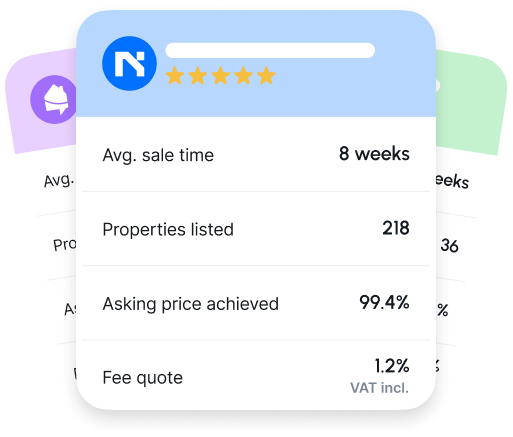
- Their average percentage of asking price achieved - this reflects how accurately they price properties and how effectively they negotiate
- Their average time to sell in the local area
- Verified customer reviews from previous sellers
- What is included in their contract
GetAgent's free comparison tool shows the performance of every local estate agent based on real completed sales. Over 1.2 million UK homeowners have used GetAgent to compare local estate agents before choosing who to instruct.
Under the Estate Agents Act 1979, all agents are legally required to confirm their fees and contract terms in writing before the seller commits. Key contract terms to understand include the tie-in period, notice period and whether the agreement is a sole agency or sole selling rights.
Step 4 - Get an Energy Performance Certificate
A valid Energy Performance Certificate (EPC) is a legal requirement before a property can be marketed for sale. EPCs rate the property's energy efficiency from A to G and are valid for 10 years. The government's EPC register can be checked to see whether a current certificate exists. If a new one is needed, an assessor typically charges between £60 and £120.
Step 5 - Agree on a marketing strategy and asking price
Once an agent is instructed, the agreed-upon asking price and marketing approach are set. This typically involves:
- Professional photography and a floor plan
- A written listing on major property portals
- Agreement on how viewings will be handled and how the agent will provide feedback
- Confirmation of the tie-in period and notice period in the contract
Under the Property Ombudsman's Code of Practice, agents must be transparent about all charges and contract terms before the seller commits.
Step 6 - Prepare the property for sale
First impressions matter both in photographs and in person. Before the property goes live:
- Declutter all rooms, including storage areas buyers will want to see
- Clean thoroughly, paying particular attention to kitchens and bathrooms
- Address obvious maintenance issues - dripping taps, sticking doors, broken fittings
- Tidy the exterior - a clean front door, clear paths and a tidy garden all contribute to first impressions
Step 7 - Go live and manage viewings
Once the listing is live, the agent handles viewing enquiries and accompanies buyers around the property. During this period, it is worth:
- Staying flexible about viewing times to maximise the number of buyers who see the property
- Keeping the property tidy and well-presented for each viewing
- Asking the agent for regular feedback from viewings
- Reviewing with the agent after two to three weeks if interest is lower than expected
Step 8 - Receive and consider offers
Estate agents are required to pass on all offers in writing. When offers are received, it is worth considering the buyer's position - whether they are chain-free, whether they have a mortgage in principle or confirmed funds, and how committed they appear to proceeding. The agent handles negotiations on the seller's behalf. For context on how long this stage can take, see our guide to how long it takes to sell a house.
Step 9 - Instruct a conveyancing solicitor
Once an offer is accepted, a conveyancing solicitor is needed to handle the legal transfer of ownership. It is advisable to choose a solicitor at the same time as instructing an estate agent, so there is no delay once an offer comes in.
The conveyancing process covers title checks, contract preparation, property searches and the exchange and completion of contracts. It typically takes 12-16 weeks. For a breakdown of what conveyancing costs, see our guide to conveyancing fees.
For guidance on the conveyancing process, Citizens Advice provides a clear overview of buyer and seller rights and obligations throughout the process.
Step 10 - Exchange and complete
Exchange of contracts is the point at which the sale becomes legally binding. Both parties sign identical contracts, and the buyer pays a deposit - usually 10% of the purchase price. A completion date is agreed upon at this point.
On completion day, the buyer's solicitor transfers the full purchase price to the seller's solicitor, who pays off any outstanding mortgage, deducts the agent's fee and conveyancing costs, and transfers the remainder to the seller. The estate agent releases the keys to the buyer.
How long does selling a house take?
The process from listing to completion typically takes three to six months, though this varies by area and market conditions. GetAgent's data shows that in London, properties take an average of 17 weeks to go under offer, 13 weeks in Cardiff and 12 weeks in Manchester. The conveyancing process after an offer is accepted typically adds a further 12-16 weeks.
| Location | Average time to go under offer |
|---|---|
| London | 17 weeks |
| Cardiff | 13 weeks |
| Manchester | 12 weeks |
How much does it cost to sell a house?
The main costs are the estate agent's fee and conveyancing costs. According to GetAgent's own research, the average agent fee is 1.18% plus VAT (1.42% including VAT). Conveyancing fees for sellers typically range from £1,000 to £2,500. For a full breakdown, see our guide to estate agent costs when selling.
FAQs
How do I start the process of selling my house?
The first step is to get an idea of the property's value by inviting local estate agents to carry out a valuation. GetAgent's free comparison tool shows the track record of every local agent so you can compare them before deciding who to instruct.
How long does it take to sell a house in the UK?
The process from listing to completion typically takes three to six months. The time to find a buyer varies by area - GetAgent's data shows an average of 17 weeks in London, 13 weeks in Cardiff and 12 weeks in Manchester. The conveyancing process after an offer is accepted typically takes a further 12-16 weeks.
Do I need an estate agent to sell my house?
It’s possible to sell privately or through an online listing service without a traditional estate agent. However, full-service agents handle marketing, viewings, negotiation and sales progression. While the right approach depends on the seller's circumstances, most homeowners find selling with a traditional estate agent much safer and easier.
Can I sell my house without paying off my mortgage first?
Yes. The outstanding mortgage is repaid from the sale proceeds on completion day, handled by the conveyancing solicitor. There is no need to pay off the mortgage before listing. If on a fixed-rate deal, early repayment charges may apply - it is worth checking the mortgage terms before listing.
What happens if my house sale falls through?
If a sale falls through before exchange of contracts, neither party is usually legally obligated to proceed with the transaction. However, costs already incurred - such as solicitor fees, surveys, mortgage fees or searches - may not be recoverable. After exchange, the agreement becomes legally binding, and pulling out can carry significant financial consequences.
Thinking about
selling your home?
Picking the right estate agent is vital for a successful sale. GetAgent makes choosing simple. Discover the best performing agents in your area.
- Free
- Data-driven
- No obligation
Thinking about
selling your home?
Picking the right estate agent is vital for a successful sale. GetAgent makes choosing simple. Discover the best performing agents in your area.
- Free
- Data-driven
- No obligation
Compare estate agents
It takes 2 minutes.




Get in touch
020 3608 6556
Our lines are closed
We are a company registered in England & Wales, company number 09428979.
Copyright © 2026 GetAgent Limited